Stump Grinding vs. Stump Removal: Which One Your Florida Project Needs
Short answer
Choose stump grinding when you want stumps gone from a lawn, pasture, trail or mowing area. A grinder chips each stump to a set depth below grade and leaves the roots to rot in place, with little ground disturbance. Choose stump removal (grubbing) when something will be built on that spot, such as a slab, septic drainfield, driveway, pool or pond. An excavator or dozer pulls out the stump and its main roots, which leaves a hole to backfill and debris to haul.
On this page
Every clearing job ends with the same question: what about the stumps? The answer depends almost entirely on what you’re going to do with that spot of ground.
The two methods
Stump grinding uses a grinder, a rotating cutting wheel with carbide teeth, to chip the stump down below the surface. The chips fill the hole or get raked out. The roots stay in the ground and decompose over time. Ground disturbance is limited to the stump’s footprint.
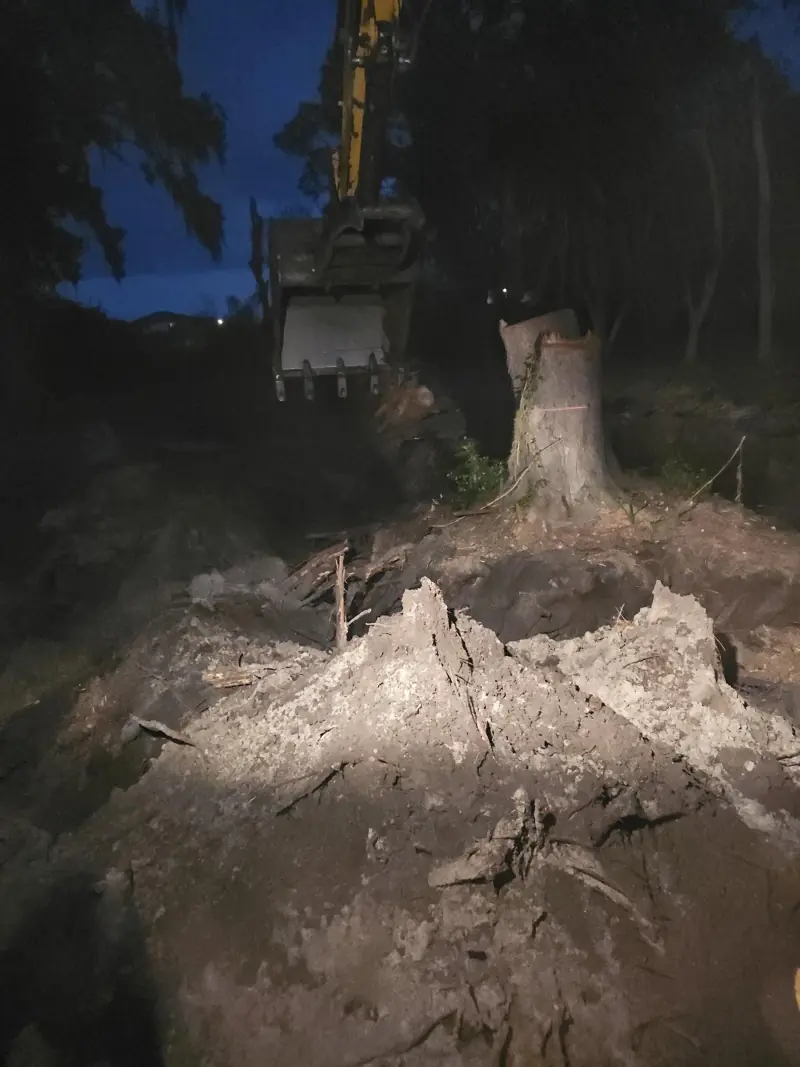
Stump removal, or grubbing, uses an excavator, dozer or backhoe to pull the stump and its main roots out of the ground. It leaves a hole that needs backfill, and a root ball covered in soil that has to be hauled, ground or otherwise handled.
Quick decision guide
| What’s going on that spot | Grind or remove? | Why |
|---|---|---|
| Lawn or sod | Grind | Clean surface, minimal disturbance |
| Pasture or hay field | Grind (or cut flush) | Protects mowers and equipment, keeps soil in place |
| Trail or firebreak | Cut flush or grind high stumps | Only stumps that catch tires or blades need work |
| House slab or footings | Remove (grub) | Decaying roots can leave voids under structure |
| Septic tank or drainfield | Remove (grub) | Drainfield needs clean, uniform soil |
| Driveway or parking | Remove (grub) | Prevents settlement and soft spots |
| Pool, pond or retention area | Remove (grub) | Excavation goes deeper than the stump anyway |
| Garden bed or new tree planting | Grind deep | Clears space for roots and soil |
| Invasive tree stumps (e.g. Brazilian pepper) | Grind or cut + treat | Cut stumps resprout unless treated |
Side by side
| Stump grinding | Stump removal (grubbing) | |
|---|---|---|
| Removes | Stump to a set depth below grade | Stump and main roots |
| Roots left in ground | Yes; they decay over time | Mostly removed |
| Ground disturbance | Small, localized | Large hole per stump |
| Debris | Wood chips (spread or hauled) | Root balls with soil (haul or grind) |
| Backfill and compaction | Usually not needed | Needed under structures |
| Equipment | Stump grinder | Excavator, dozer, backhoe |
| Speed for a few yard stumps | Fast | Slower, more cleanup |
| Speed for a whole build pad | Slow (stump by stump) | Efficient as part of site work |
| Good under buildings and drives | No | Yes |
| Utility locate needed | Yes (below-grade) | Yes |
What drives the cost
Whether you grind or remove, these factors decide where your job prices:
- Number and diameter of stumps. A few big oak stumps can take longer than dozens of small pines.
- Species and condition. Hardwoods like oak are tougher to grind than pine. Old, rotted stumps go faster.
- Root flare and surface roots. Wide oak root flares mean more grinding.
- Access. Fences, gates, slopes and soft ground limit equipment size.
- Cleanup. Raking chips into the hole, hauling chips, or backfilling and compacting holes.
- Nearby hazards. Utilities, irrigation, foundations and sidewalks slow the work down.
We price stump work after seeing it. Our DeLand page covers stump grinding in more detail.
What happens to roots left in the ground?
After grinding, the remaining roots slowly decompose. Over time you may see:
- Small settling where the stump was, which can be topped off with soil.
- Mushrooms around the area as roots break down. They’re harmless.
- Sprouts from some species. Brazilian pepper, camphor and some oaks can resprout from root systems. Treat sprouts if they appear.
None of that matters for a lawn or pasture. It’s exactly why roots shouldn’t stay under a slab or septic drainfield.
Where forestry mulching fits
Forestry mulching cuts brush and small trees at or near ground level. It does not remove stumps. Many projects use a combination:
- Mulch the whole area to clear brush without debris piles.
- Grind stumps in lawn, mowing and trail areas.
- Grub stumps in the building, driveway and septic footprint.
That mix keeps disturbed ground and hauling to a minimum while giving you a build-ready pad where you need it. Read more in can forestry mulching remove stumps? and clearing vs. grubbing vs. stripping.
Before any below-grade stump work
- Call or have your contractor call Sunshine 811 at least 2 full business days ahead. See 811 for clearing jobs.
- Mark private lines: well, irrigation, septic, barn power, propane.
- Agree on grinding depth and chip cleanup in writing.
- For grubbing, agree who backfills, compacts and hauls root balls.
- Check tree permits before removing any trees whose stumps you'll be dealing with.
Call or text us photos of the stumps and tell us what’s going on that ground next. We’ll tell you whether grinding or removal makes sense and what it will take.
Frequently asked questions
How deep does stump grinding go?
Depth depends on the machine and what you ask for. Grinding is typically specified to a few inches below grade for lawns and mowing, and deeper where you plan to plant or lay sod. Agree on the depth in writing before the job.
Can I build over a ground stump?
Generally not under structural elements. Roots left in the ground decompose and can leave voids and soft spots. Builders and engineers usually require stumps and roots grubbed out under slabs, footings, driveways and septic systems.
Which is cheaper, stump grinding or stump removal?
For a few stumps in a yard or field, grinding is usually cheaper and much less disruptive. For a building pad, grubbing is typically done as part of site work, and it's the right method even though it costs more per stump.
Does stump grinding need an 811 call?
Grinding below grade disturbs the ground, which fits Florida's definition of excavation. Treat it like digging and request locates through Sunshine 811 at least 2 full business days ahead, especially near roads, meters and service lines.
Will forestry mulching remove stumps?
No. Forestry mulching cuts stumps at or near ground level. If stumps need to go, add grinding (for mowing and lawn areas) or grubbing (for build areas).
Sources and official references
Rules change. Confirm requirements for your parcel with the agency before you clear. This article is general information, not legal advice.
Talk to us about stump grinding
Send us the address and a few photos. We'll walk the property and give you a written scope and price.
Request a free estimate
Tell us where the property is, roughly how big it is and what you want done. We review every request before quoting, and a site visit is part of every written quote. Prefer to talk? Call (386) 675-7898 or text us photos.