Land Clearing for Construction: Complete Site Prep Guide for Florida
Land clearing for construction is the process of removing all trees, stumps, brush, and debris from a building site, followed by rough grading to create a stable, level surface suitable for pouring a foundation, laying a slab, or installing utilities. It is the first and most critical phase of any Florida construction project.
Whether you are building a home in DeLand, a commercial facility in Daytona Beach, or a barn on rural Volusia County acreage, land clearing and site preparation are the foundation of everything that comes after. Get this phase wrong — missed stumps, improper grading, uncontrolled erosion — and every construction step that follows is compromised.
This guide walks you through the complete process: from the initial survey to the final grade, the permits you need, what contractors look for, and what the whole thing costs in Central Florida.
What is Site Preparation for Construction?
Site preparation (also called "site prep" or "grubbing and grading") is the full sequence of work that transforms raw, vegetated land into a build-ready surface. It encompasses three major phases:
- Clearing: Removing trees, brush, stumps, rocks, and organic debris
- Grubbing: Extracting root systems and underground debris
- Grading: Moving and compacting soil to achieve the correct elevation, slope, and drainage plan
Many property owners and even some contractors treat clearing and grading as interchangeable — they are not. Clearing removes what is above ground. Grading shapes what is below. Both must be completed correctly before any structural work begins.
Step-by-Step: How Land Clearing for Construction Works
Step 1: Property Survey and Staking
A licensed surveyor marks the property boundaries, building setbacks, easements, and any wetland delineation lines. This defines exactly what can and cannot be cleared. Never clear without a current survey — accidental encroachment on adjacent property or protected habitat creates costly legal and regulatory problems.
Step 2: Obtain Required Permits
In Florida, most construction clearing requires permits before any equipment touches the ground. Common requirements in Volusia County include:
- Tree Removal Permit — Required for removing protected species or clearing more than a specified canopy percentage
- Land Clearing Permit — Required in many municipalities for clearing above a minimum acreage threshold
- NPDES / Stormwater Permit — Required by the EPA for earth disturbance over one acre; involves an Erosion & Sediment Control Plan (ESCP)
- SJRWMD Environmental Resource Permit — Required when clearing near wetlands or flood zones
Your general contractor often coordinates permits, but hiring a land clearing company experienced with Volusia County regulations saves significant time. See our full Florida permitting guide.
Step 3: Utility Locates (Call 811)
Florida law requires calling 811 to have underground utilities marked before any digging. This identifies buried gas lines, water mains, electric conduit, and fiber optic cables. The call is free and typically completed within 3 business days. Equipment operators must respect all marked lines.
Step 4: Clearing Vegetation and Trees
This is where land clearing contractors take over. The right method depends on the vegetation type and the project:
- Forestry mulching for dense palmettos, scrub oaks, and mixed Florida underbrush — fast, no hauling, eco-friendly
- Chainsaw crews + equipment for large timber that exceeds mulcher capacity
- Excavator with grapple for selective tree removal near structures or protected trees
All vegetation within the building footprint and a buffer zone (typically 5–10 feet beyond the foundation) must be removed.
Step 5: Stump and Root Removal (Grubbing)
This step is non-negotiable for construction sites. Stumps and roots left in the ground decompose, creating voids that cause foundation settlement and structural failure. Options include:
- Stump grinder: Grinds to 12–18 inches below grade — acceptable for driveways and non-structural areas
- Excavator extraction: Full root ball removal — required under foundation footprints and utility trenches
- Forestry mulcher (large drum): Grinds stumps to ground level — adequate for graded fill areas, not under slabs
Step 6: Debris Handling
With forestry mulching, most organic debris is ground in place and either left as a mulch blanket or raked aside before grading begins. With traditional clearing, debris is piled and either hauled to a licensed facility, chipped on-site, or burned where permitted. Hauling fees add $500–$2,000+ per load depending on volume.
Step 7: Rough Grading
A bulldozer or motor grader establishes the rough elevation across the site according to the civil engineering plan. This shapes the building pad, creates proper drainage slope (typically a minimum 2% grade away from the structure), and identifies any fill areas that need compaction.
Step 8: Soil Compaction and Testing
Fill areas must be compacted in lifts (6–12 inch layers) and tested with a soil density gauge (Proctor test or nuclear densometer). Florida's sandy soils require careful attention — loose fill under a slab will cause cracking. Many building departments require a soil compaction report before a foundation permit is issued.
Step 9: Erosion and Sediment Controls
Silt fences, turbidity barriers near water bodies, and stabilized construction entrances are installed and maintained throughout the construction process. Florida's rain events are intense; bare cleared sites generate serious erosion and stormwater runoff violations without controls in place.
Step 10: Final Grade and Inspection
The final grade is verified against the approved engineering plan, drainage swales are shaped, and the site is inspected by the local building department. Only after passing this inspection can foundation work legally begin on most Florida projects.
Site Prep Phases: Timeline Overview
| Phase | Typical Duration | Who Performs It |
|---|---|---|
| Survey and Staking | 1–3 days | Licensed Surveyor |
| Permitting | 1–6 weeks | Owner / GC / Clearing Crew |
| Utility Locates | 3–5 business days | Call 811 (free) |
| Vegetation Clearing | 1–5 days | Land Clearing Contractor |
| Stump / Root Grubbing | 1–2 days | Land Clearing Contractor |
| Debris Handling / Haul Off | 1–2 days | Clearing or Haul Crew |
| Rough Grading | 1–3 days | Grading Contractor |
| Compaction and Testing | 1–2 days | Geotechnical Engineer |
| Erosion Controls | Ongoing | GC / Clearing Crew |
| Final Grade Inspection | 1 day | Building Department |
What Contractors Need from Land Clearing Before Building
General contractors and foundation crews need the cleared site to meet specific standards before they can begin their work:
- Zero organic material under the building footprint — all roots, stumps, and topsoil removed to expose mineral subsoil
- Correct rough grade elevation — within 0.1–0.2 feet of the engineering plan
- Stable access road — equipment must reach the site without damaging utilities or site prep
- Erosion controls in place — required before concrete trucks or material deliveries begin
- Clearly marked protected zones — any trees, utilities, or features to be preserved are flagged with barrier tape
Coordinating early with your land clearing contractor and GC prevents rework. We regularly work alongside general contractors across Volusia, Seminole, and Lake Counties.
How Much Does Construction Site Prep Cost in Florida?
| Service | Cost Range | Notes |
|---|---|---|
| Residential Lot Clearing (under 1 acre) | $800 – $3,500 | Varies by vegetation density |
| Forestry Mulching (per acre) | $400 – $1,500 | Includes stump grinding to grade |
| Full Grubbing (root extraction) | $200 – $800 | Per acre, additive to clearing |
| Rough Grading (per acre) | $500 – $2,000 | Depends on cut/fill volume |
| Debris Haul-Off | $500 – $2,000 per load | If not mulched on-site |
| Soil Compaction Testing | $300 – $800 | Geotechnical lab report |
| Erosion Controls (silt fence) | $2 – $5 per linear foot | Required by NPDES permit |
| Full Site Prep Package (1 acre, light brush) | $2,000 – $5,000 | Clearing + grading + controls |
| Full Site Prep Package (1 acre, heavy timber) | $4,000 – $10,000+ | Clearing + grubbing + grading |
For the most accurate quote, call us at 386-675-7898 for a free on-site assessment. We serve the entire Central Florida region.
Forestry Mulching vs. Traditional Clearing for Construction
| Factor | Forestry Mulching | Traditional (Bulldoze + Haul) |
|---|---|---|
| Speed | Fast (1–3 acres/day) | Moderate (depends on haul schedule) |
| Debris Handling | Ground on-site, no hauling | Hauled off — adds cost and time |
| Topsoil Preservation | Excellent | Poor — topsoil often lost |
| Stump Removal | Ground to grade | Extracted or buried (risk of voids) |
| Under-Foundation Use | Requires grubbing supplement | Yes (with excavator grubbing) |
| Erosion Risk During Work | Low | High (bare soil exposed) |
| Best For | Residential lots, light-medium commercial | Large commercial, heavy timber |
| Total Cost | Lower (no haul fees) | Higher (haul + equipment combo) |
Before and After: Construction Site Clearing
Densely wooded lot — no access for equipment
Multiple large oaks and palmettos on footprint
Unknown soil conditions, possible wetland areas
Cannot begin building permit application
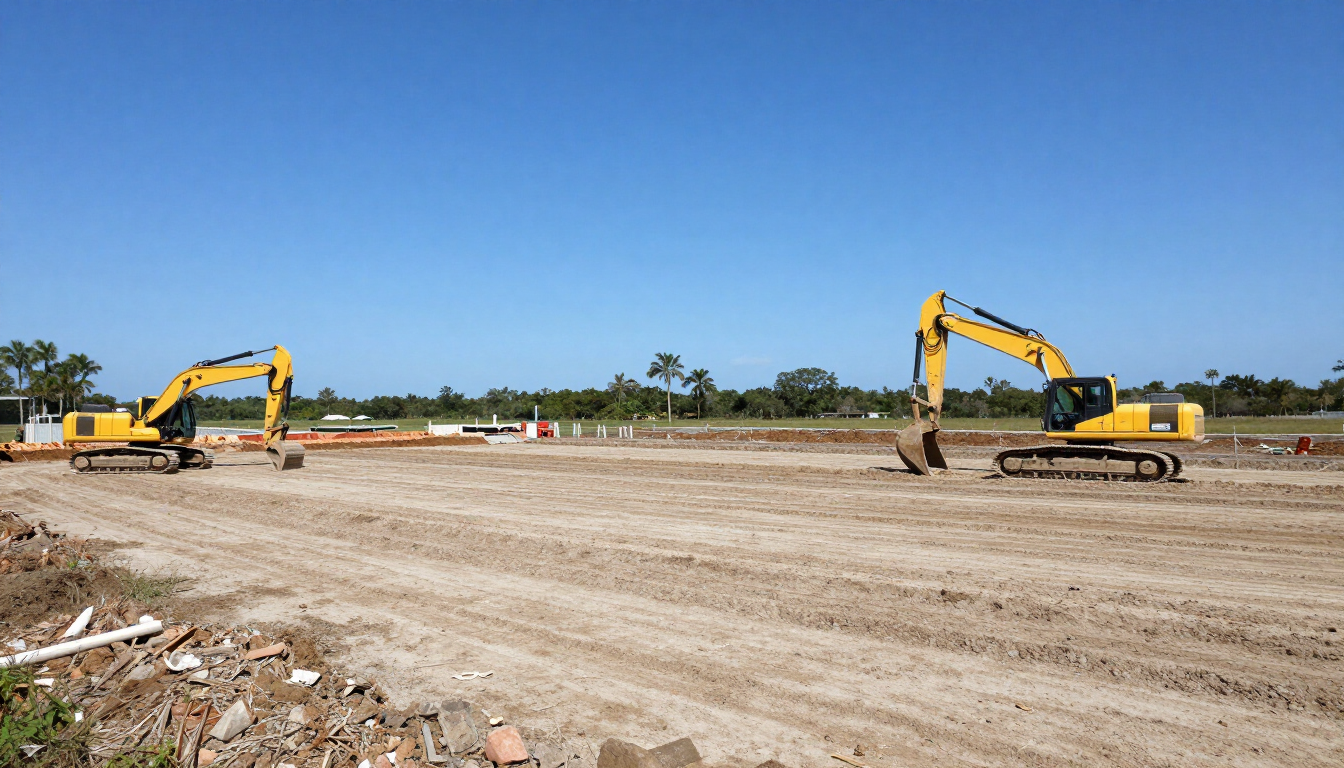
Clean, graded surface — foundation crew ready to mobilize
All stumps removed under footprint zone
Drainage grade set, silt fence installed
Passed building department site inspection
Internal Resources
- Site Preparation Services — Full construction site prep overview
- Land Clearing Services — What we clear and how
- Lot Clearing — Residential lot prep for building
- Forestry Mulching — Best clearing method for Florida
- Acreage Clearing — Large-scale construction prep
- Commercial Land Clearing — Developer and contractor services
- What is Land Clearing? — Complete beginner's guide
- Volusia County Permits — Navigate local clearing regulations
Preparing Land for Construction in Central Florida?
We coordinate with your general contractor, pull permits, and deliver a build-ready surface. Serving DeLand, Deltona, Daytona Beach, Ormond Beach, New Smyrna, and all of Volusia County.
Call or Text 386-675-7898Frequently Asked Questions
What is land clearing for construction?
Land clearing for construction means removing all trees, stumps, brush, and debris from a building site and grading the soil to create a stable, level surface that can support a building foundation, driveway, or other structure.
What steps are involved in site preparation for construction?
The main steps are: (1) Survey and marking, (2) Permitting, (3) Clearing vegetation and trees, (4) Stump and root removal, (5) Debris hauling or mulching, (6) Rough grading, (7) Soil compaction testing, and (8) Final grade and drainage layout.
How long does land clearing take before construction?
Residential lot clearing typically takes 1–3 days. A multi-acre construction site with dense vegetation may take 1–2 weeks. Weather, soil conditions, and debris handling all affect the timeline.
How much does site preparation cost in Florida?
Site prep costs in Florida range from $1,500 to $5,000+ per acre for full clearing and grading. A standard residential lot (under 1 acre) typically costs $800 to $3,500 depending on vegetation and grading needs.
Do I need a permit to clear land for construction in Florida?
Yes. Most construction clearing in Florida requires a Land Clearing Permit, Tree Removal Permit, and in some cases a Stormwater/NPDES permit for erosion control. Your general contractor often pulls these, but the land clearing crew should coordinate with them.
Can forestry mulching be used for construction site prep?
Yes — forestry mulching is ideal for the vegetation clearing phase. It quickly removes brush and small trees while leaving mulch that can be removed or worked into the soil. For final grading and compaction, an excavator and grader are needed after mulching.
What is the best time of year to clear land for construction in Florida?
The dry season (November through April) is ideal for Florida land clearing and site prep. Lower soil moisture improves equipment traction and reduces compaction damage. Wet season clearing is possible but may require additional erosion controls.
What should I ask a land clearing contractor before hiring them?
Ask: Are you licensed and insured in Florida? Do you handle permits? What equipment will you use? Will you remove stumps? What happens to the debris? Can you coordinate with my general contractor? Do you offer a written estimate?
How do I find a land clearing contractor near me in Florida?
Search for licensed, insured land clearing contractors in your county. For Central Florida and Volusia County, Florida Land Clearing serves DeLand, Deltona, Daytona Beach, Ormond Beach, New Smyrna, Orlando, and surrounding areas.