What is Land Clearing? Complete Guide for Florida Property Owners
Land clearing is the process of removing trees, stumps, brush, undergrowth, rocks, and other obstacles from a piece of land to prepare it for construction, agriculture, landscaping, or recreational use. It is one of the first and most essential steps before any building project or property improvement in Florida.
If you own raw land, a wooded lot, or an overgrown property in Central Florida, you have probably asked: what exactly is land clearing and do I need it? This guide answers that question in plain language, covering every method, piece of equipment, cost range, and legal consideration specific to Florida property owners.
The Core Definition: What Does Land Clearing Mean?
Land clearing means transforming raw, vegetated, or overgrown land into a usable surface. The process involves:
- Cutting and removing trees and large shrubs
- Grinding or pulling stumps
- Mowing and mulching dense underbrush
- Removing rocks, debris, and old structures
- Grading the surface for drainage (when required)
The end goal depends on your project — a new home foundation needs a fully graded, debris-free surface, while a hunting property may only need trails opened and brush thinned for better access and visibility.
Why Do Property Owners Clear Land in Florida?
Florida's subtropical climate causes vegetation to grow densely and fast. Common reasons Central Florida property owners hire land clearing professionals include:
- New home or structure construction — Building permits require cleared, compacted land before a foundation is poured.
- Subdivision development — Developers clear lots before road grading and utility installation.
- Fire prevention — Dense palmetto and dried brush are extreme wildfire hazards, especially during Florida dry seasons.
- Code enforcement compliance — Counties can fine homeowners for overgrown lots that create nuisance or safety hazards.
- Pasture and agricultural restoration — Old grazing land gets reclaimed from invasive species like Brazilian pepper and cogongrass.
- Hunting and recreation — Food plots, shooting lanes, and walking trails require strategic brush removal.
- Property value improvement — Cleared land is significantly more marketable and appraised higher than overgrown parcels.
The 5 Main Types of Land Clearing
Not all land clearing is the same. The right method depends on your land's vegetation, intended use, and budget.
1. Forestry Mulching
Forestry mulching uses a single machine with a high-speed drum and carbide teeth to cut, grind, and spread all vegetation in one pass. It is the most popular method in Florida because it handles palmettos, scrub oaks, and dense underbrush without hauling debris. The resulting mulch layer protects topsoil and breaks down into natural fertilizer.
2. Brush Hogging (Rotary Cutting)
Brush hogging uses a tractor-mounted rotary cutter to mow down tall grass, weeds, and small saplings. It is the most affordable method, best for fields, pastures, or lots with light vegetation under 3 inches in diameter. It does not remove stumps or roots.
3. Bulldozing and Pushover Clearing
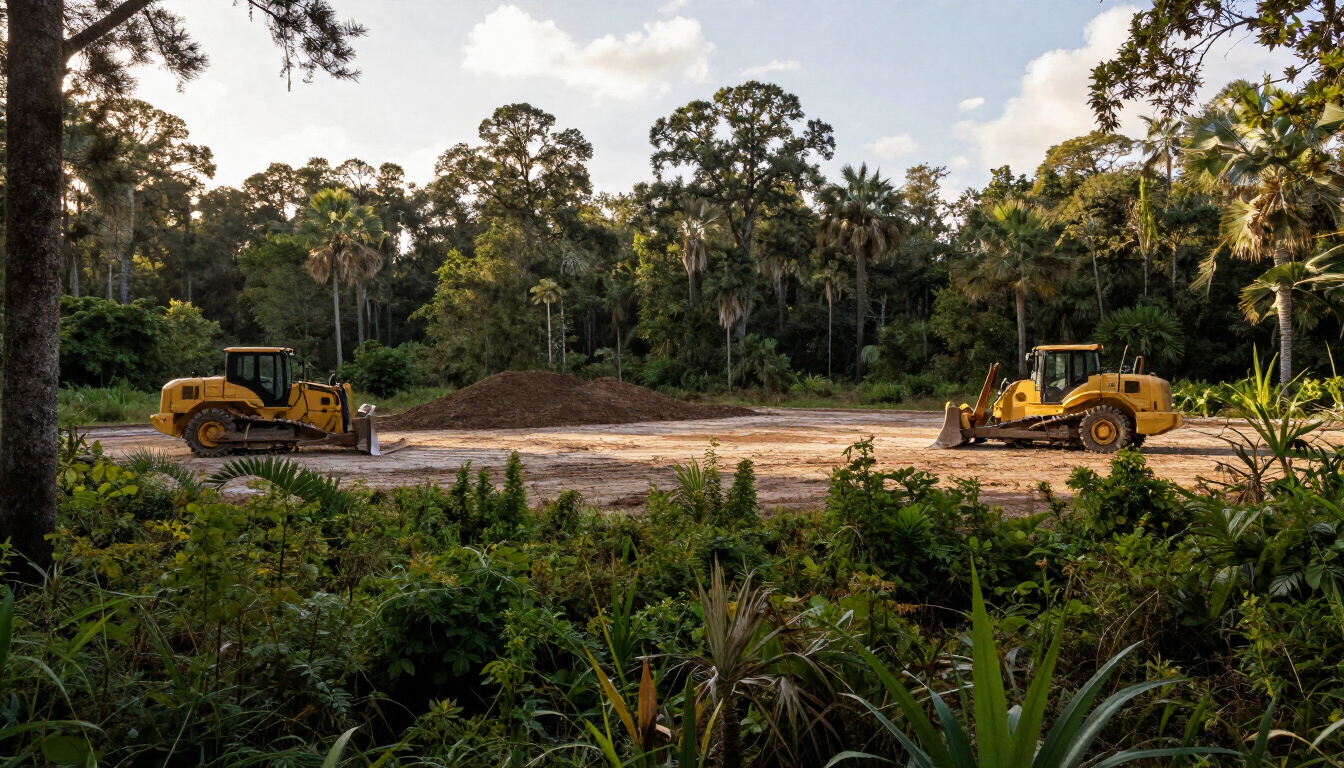
A bulldozer uses raw force to knock over trees and push debris into piles. It is fast for large acreage but destroys topsoil, requires debris hauling, and is typically more expensive when you factor in dump fees and restoration work. Best reserved for large commercial developments with thick timber.
4. Hand Clearing
Crews with chainsaws, axes, and hand tools remove selective vegetation. It is precise and appropriate near protected trees or tight residential spaces, but it is slow and labor-intensive on any significant acreage.
5. Chemical Clearing
Herbicides kill invasive plants and undergrowth over time. Effective for cogongrass, Brazilian pepper, and other invasive species management, but not appropriate for construction preparation since it leaves dead vegetation in place for months.
Land Clearing Methods Comparison
| Method | Best For | Cost Range/Acre | Debris Handling | Soil Impact |
|---|---|---|---|---|
| Forestry Mulching | Dense Florida brush, residential & acreage | $600–$1,500 | Left on-site as mulch | Minimal — protects topsoil |
| Brush Hogging | Fields, pastures, light overgrowth | $150–$500 | Mowed in place | Low |
| Bulldozing | Large commercial sites, heavy timber | $1,000–$3,000+ | Piled & hauled | High — destroys topsoil |
| Hand Clearing | Selective removal, tight spaces | $500–$2,000+ | Hauled or chipped | Very Low |
| Chemical | Invasive species control | $200–$800 | Decomposes over months | Low |
Equipment Used in Professional Land Clearing
Understanding the machinery helps you evaluate contractor bids and know what to expect on your property:
- Forestry Mulcher (Tracked or Wheeled): A dedicated machine or skid steer attachment with a carbide drum. Handles trees up to 8–12 inches in diameter. The workhorse of modern Florida land clearing.
- Bulldozer (D6–D9): Massive crawler tractor that pushes and piles material. Used on large commercial sites with heavy timber.
- Excavator: Used for stump removal, ditch clearing, and precision work near structures or water bodies.
- Skid Steer Loader: Compact and maneuverable, fits through gates and tight spaces. Paired with mulching or grapple attachments for residential lots.
- Brush Hog / Rotary Cutter: Tractor attachment that mows vegetation up to 3 inches. Fast and affordable for open fields.
- Stump Grinder: Dedicated machine to grind stumps below grade after chainsaw felling.
- Chipper: Converts branches and small trees into wood chips for disposal or landscape use.
How Much Does Land Clearing Cost in Florida?
Cost depends on vegetation density, terrain, acreage, and method. Here are realistic ranges for Central Florida in 2024–2026:
| Service | Price Range | Unit |
|---|---|---|
| Light Brush Hogging | $150 – $400 | Per Acre |
| Medium Forestry Mulching | $600 – $1,000 | Per Acre |
| Heavy Forestry Mulching (dense timber) | $1,000 – $1,800 | Per Acre |
| Residential Lot Clearing (< 1 acre) | $500 – $2,500 | Flat Rate |
| Full Acreage + Grading Prep | $1,500 – $5,000+ | Per Acre |
Get an exact quote: view our land clearing services or call us at 386-675-7898 for a free on-site estimate.
Do You Need a Permit to Clear Land in Florida?
Florida land clearing permits vary by county. In Volusia County, the following generally apply:
- Removing more than 50% of protected trees on a parcel requires a Tree Removal Permit.
- Clearing within 25 feet of a wetland boundary requires a St. Johns River Water Management District (SJRWMD) Environmental Resource Permit.
- Commercial clearing of more than one acre may require a Stormwater/NPDES permit to control erosion and runoff.
- Some municipalities (DeLand, Ormond Beach, Daytona Beach) have additional local tree ordinances.
Our team guides clients through the permitting process. Read our full Volusia County permit guide.
Before and After: What to Expect
Dense palmettos, scrub oaks, and invasive brush
Impassable terrain — no sight lines or access
Fire hazard, code violation risk
Low property value and appeal
Clean, accessible land with mulch ground cover
Full visibility for construction layout or recreation
Fire-safe buffer zones maintained
Higher appraised value and build-ready surface
Internal Resources
- Land Clearing Services — Full service overview and quote request
- Forestry Mulching Services — Florida's best clearing method explained
- Brush Hogging — Affordable field and pasture clearing
- Site Preparation — Construction-ready land prep services
- Lot Clearing — Residential lot clearing for building
- Volusia County Permits — Permitting requirements explained
Ready to Clear Your Land?
We serve DeLand, Deltona, Daytona Beach, Ormond Beach, New Smyrna, and all of Central Florida. Get a free on-site estimate today.
Call or Text 386-675-7898Frequently Asked Questions
What is land clearing?
Land clearing is the process of removing trees, stumps, brush, undergrowth, rocks, and other obstacles from a piece of land to make it usable for construction, agriculture, landscaping, or recreation.
How long does land clearing take?
A professional crew can clear 1–3 acres per day depending on vegetation density and terrain. A standard residential lot typically takes one full day. Large acreage projects may take several days to a week.
How much does land clearing cost in Florida?
Land clearing in Florida costs between $400 and $1,500+ per acre. Light brush hogging runs $200–$600/acre, while heavy forestry mulching in dense woodland can reach $800–$2,000/acre depending on conditions.
Do I need a permit to clear land in Florida?
Permit requirements depend on your county, the size of the area being cleared, and whether protected trees or wetlands are involved. In Volusia County, clearing more than half an acre typically requires a Tree Removal Permit.
What is the best land clearing method in Florida?
Forestry mulching is widely considered the best method for Florida properties. It handles palmettos, oaks, and dense underbrush in one pass without hauling debris, protects topsoil, and is more cost-effective than bulldozing.
What equipment is used for land clearing?
Common land clearing equipment includes forestry mulchers, bulldozers, excavators, skid steer loaders, brush hogs (rotary cutters), and stump grinders. The right equipment depends on the size, terrain, and type of vegetation.
Can I clear land myself in Florida?
Small brush clearing on private property can be DIY, but anything involving large trees, stumps, or significant acreage requires professional equipment and, often, permits. Improper clearing can violate county tree ordinances and damage soil.
What happens to the debris after land clearing?
With forestry mulching, debris is ground into a fine mulch layer that stays on-site and decomposes naturally. With traditional clearing (bulldozing), debris is piled and either hauled off, burned (where permitted), or chipped separately.
Is land clearing bad for the environment?
Traditional clearing methods can cause erosion and soil loss. However, forestry mulching is an eco-friendly alternative that retains topsoil, returns nutrients to the ground, and preserves the natural ground layer.